

A new exome sequencing study of about 42,000 individuals from the Paisa, a founder population in Colombia, has found new risk genes for serious mental illness. These newly mapped genes fill a gap that has intrigued the psychiatric genetics community for a long time.
Serious mental illnesses such as schizophrenia and bipolar disorder have a genetic architecture that differs from that of diseases of other body systems, such as cardiovascular or immune diseases. As these disorders manifest early in life, they reduce reproductive fitness and hence are under strong natural selection. Any mutation that raises the disease risk gets quickly removed from the population. At any point in time, the risk variants identifiable in the population are either common variants with minuscule effect sizes (such variants fly under the selection radar) or extremely rare variants with huge effect sizes (such variants are young and selection has not yet had time to remove them).
The skew of risk-variant effect sizes towards opposite extremes is evident from the discoveries made by past genome-wide association studies (GWAS) and exome-wide association studies (ExWAS; SCHEMA, BipEx), as illustrated in the plot below.
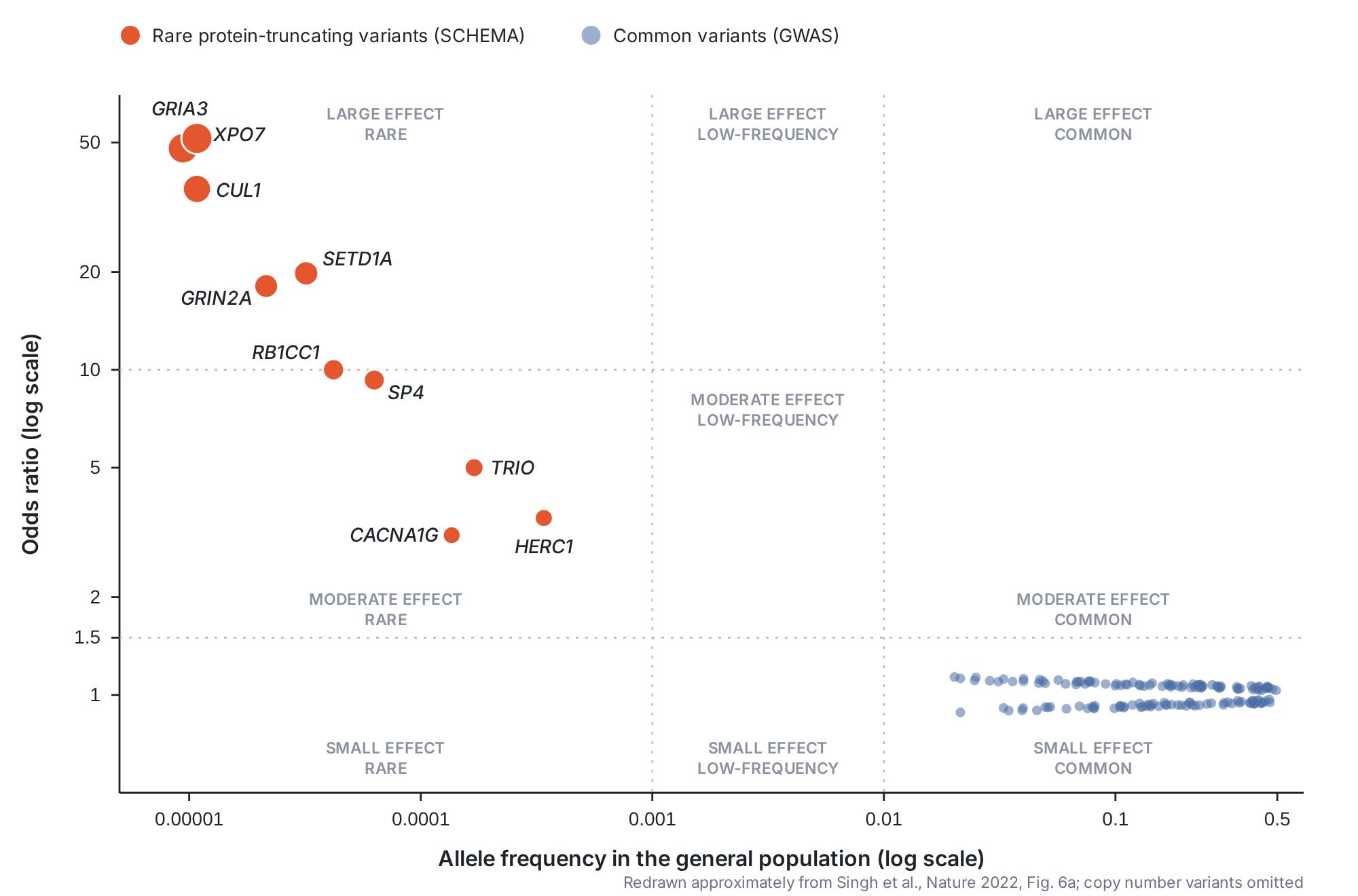
Between the two extremes lies a gap where low-frequency genetic variants sit. If risk variants of large effect existed in this gap, past GWAS and ExWAS would have found them by now, but none has turned up so far. So the conclusion was that risk variants in this low-frequency gap, if any exist, should have moderate to low effect sizes that require enormous sample sizes to detect.
Founder populations have a unique genetics that can help fill this gap where general populations could not. When a population grows fast from a small group of founders, chance alone can drift a rare variant to many times its usual frequency. So a competition between drift and selection plays out. The expectation would be that even if highly penetrant variants get weeded out faster than they can drift, moderate-effect variants could reach frequencies high enough to detect their association.
A founder population of nine million
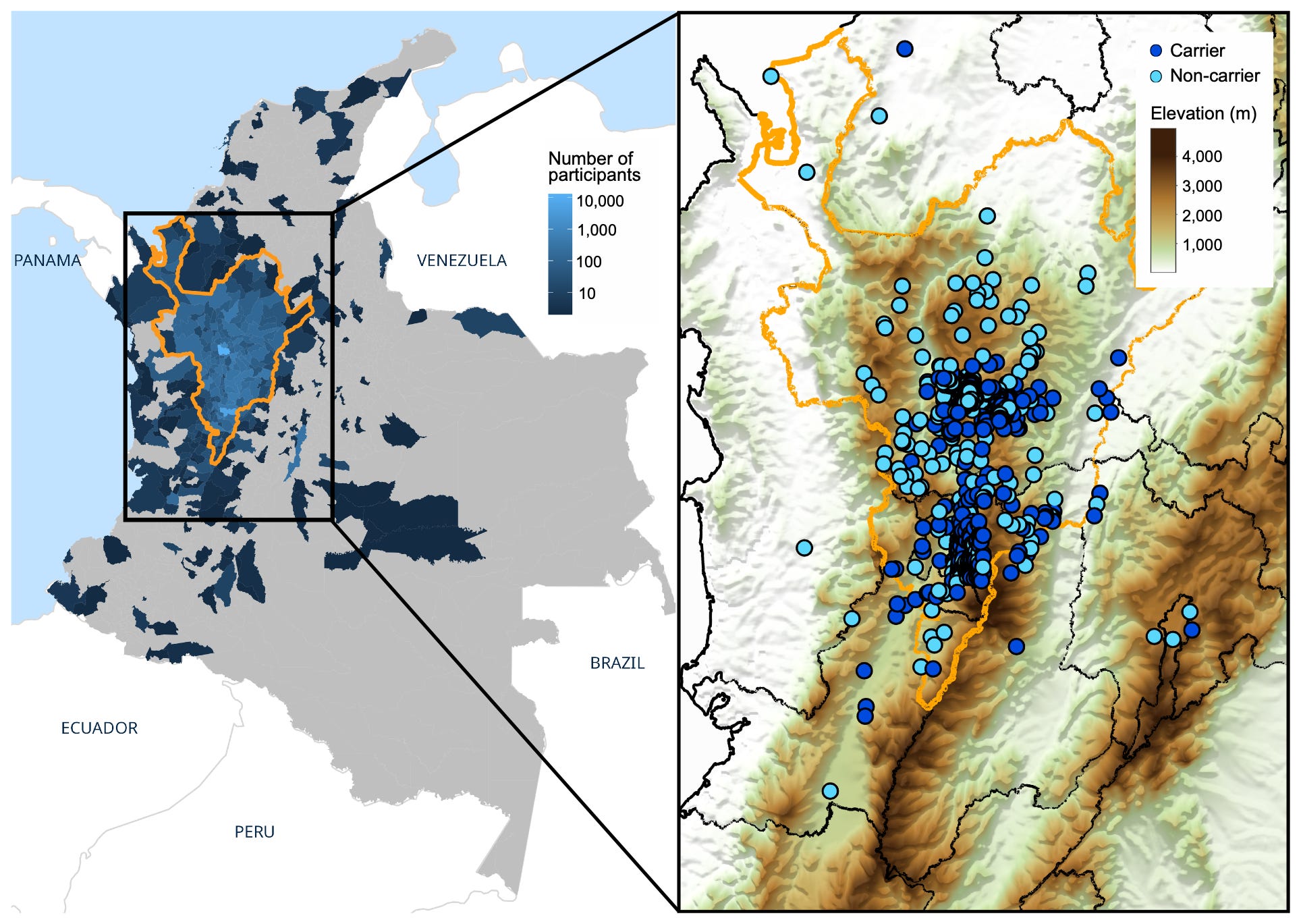
The Paisa population of northwestern Colombia provides the opportunity to test the above case. The population was founded in the 16th and 17th centuries by European colonists (mostly men), Indigenous women and enslaved Africans. It grew more than 100-fold over the following four centuries from that small founding group, with little immigration. Today, with about 9 million people, the Paisa population is one of the largest genetic isolates in the world.
The participants of the current study come from Mision Origen, a biobank built in the region for psychiatric genetics. Cases were identified through the health records of psychiatric hospitals, and controls were matched to them from primary care clinics. After quality control, about 42,000 individuals were analyzed: 22,000 with schizophrenia, bipolar disorder or severe depression, and 20,000 controls. The authors analyzed each diagnosis separately, and also together, as serious mental illness.
Deep exomes, light genomes
The participants were sequenced using an approach developed at the Broad Institute called Blended Genome Exome (BGE) sequencing. BGE sequences a single DNA library, reading the exome at high depth (30-40x) and the rest of the genome at low depth (1-4x). The deep exome covers rare variants confidently, and the light genome provides sufficient backbone to impute common variants reliably.
The analysis was restricted to variants likely to damage a protein: those that truncate it and missense changes predicted to be harmful. Low-frequency variants (0.1-1%) were tested one at a time, and rare and ultra-rare ones were collapsed per gene and tested together to increase statistical power. The top hit sits near a locus previously identified in large GWASs, so it was retested after adjusting for the common variants there, to make sure it is an independent signal.
Four founder genes land in the gap
The study found seven genes associated with serious mental illness. Four of them, ADAP1, WIPI1, NFE2L1 and FBXO10, are driven by founder variants and had not been linked to any mental disorder before. The other three include HLA-DPB1, driven by a common variant at the MHC locus, and KDM5B and ZMYM2, driven by ultra-rare variants, found in previous sequencing studies.
The most significant association is with ADAP1, driven by a protein-truncating frameshift variant carried by about 8 in every 1,000 Paisa individuals, while nearly absent elsewhere in the world: only two carriers are found in the gnomAD database. The variant is carried by 1.6% of people with schizophrenia or bipolar disorder against 0.4% of controls, increasing the risk 3.3-fold. The effect is the same for schizophrenia and bipolar disorder, and not significant for severe depression. The associations with the other three genes are also driven by founder variants: WIPI1 by a missense variant (OR=4.1), NFE2L1 by a frameshift deletion (OR=1.8), and FBXO10 by three variants that together appear to lower the disease risk (OR=0.40).
Here is the most interesting part. When placed on the effect size vs allele frequency plot of schizophrenia and bipolar disorder associations, the four genes sit in or at the edge of the gap that population-scale sequencing studies were never able to fill.
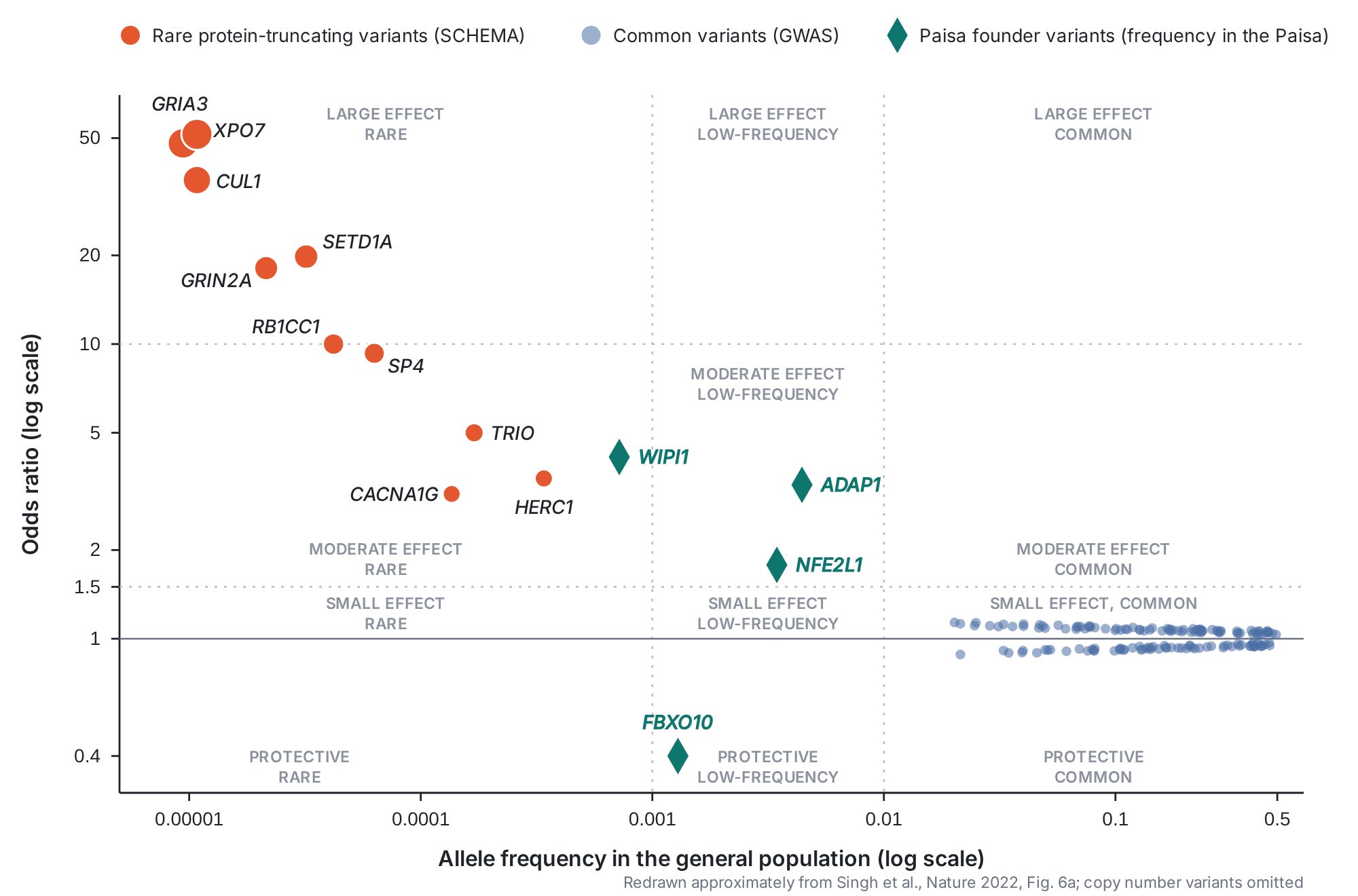
Like any discovery study, the usual caveats apply: the findings need replication (which is challenging for a founder population finding) and the effect size is likely imprecise, often an overestimate due to winner's curse.
Why drift lifted only moderate variants
The authors explain the new associations with drift outpacing selection. The recent rapid expansion of the Paisa population allowed risk variants to rise in frequency before selection had time to pull them down. That explains why these variants are far more frequent in the Paisa than elsewhere. It does not explain why their effects are moderate and not as large as the ones found in previous sequencing studies from the SCHEMA consortium based on the general population.
Selection gives a rough answer. How fast a variant is removed depends on its fitness effect, that is, how many children its carriers lose per generation, which is roughly the extra disease risk the variant brings multiplied by the drop in children that the disease causes. Over the twenty or so generations since the Paisa were founded, a variant like the one in ADAP1 (OR ~3) keeps about 80% of its starting frequency. A variant like those in SETD1A or GRIA3 (OR ~20) keeps about 19%, and one like CUL1 (OR ~44) about 4%. Drift lifts both kinds, but the large-effect ones get thinned 4-20x more along the way, so fewer of them survive to be found. Another way to look at it is gene constraint: every Paisa founder gene is less constrained than every SCHEMA gene.
ADAP1: harmless to lose in mice, risky in people
ADAP1, the gene with the strongest signal in the study, is predominantly expressed in the brain and switches on after birth. It has not been linked to a human disease before. It encodes an adapter protein that holds vesicles carrying a lipid called PIP3, tying them to a motor protein that carries the vesicles to the tip of a growing neurite. The authors raise the possibility of a toxic, amyloid-prone protein fragment, but that needs the mRNA to escape decay, which the variant's position doesn't support. The frameshift puts a stop codon early in the mRNA, in almost all of the isoforms, which should trigger nonsense-mediated decay. So the truncated protein is likely never made, and carriers make about half the normal amount of ADAP1.
While the human data show a risk effect, mouse data point the other way. Mice lacking ADAP1 develop normally, grow more dendritic spines, remember better, and are protected in models of Alzheimer's disease and multiple sclerosis. How losing one copy raises the risk of serious mental illness threefold in humans is an open question. A toxic fragment would explain it, but the variant's position argues against one; settling it needs experiments in carrier cells.
WIPI1: the last of its family to find a disease
WIPI1, the second gene to pass exome-wide significance, is an autophagy gene. It acts at the first step, where it helps build the membrane that wraps up the material to be recycled. The risk variant is a missense variant that swaps a leucine for a proline and is predicted to be damaging.
The interesting angle is that the gene is part of a family where every other member (WIPI2, WIPI3 and WIPI4) is linked to a severe childhood brain disorder. The four proteins of this family share a structure and work in the same pathway. WIPI1 is the only one without a disorder of its own, and now the Paisa study links it to serious mental illness.
NFE2L1: an altered tail in a constrained gene
NFE2L1 (also called Nrf1) controls the proteasome, the machine that shreds unwanted proteins. It sits attached to the endoplasmic reticulum membrane and acts as a stress sensor. When the proteasome is overloaded, it's cut loose and sent to the nucleus, where it switches on more proteasome genes. NFE2L1 is a constrained gene, the only one of the four founder hits, and it plays a critical role in the brain. Mice lacking this protein in the nervous system develop progressive neurodegeneration. Although NFE2L1 itself has not been directly linked to a disease in humans, deficiency of its activator, the deglycosylating enzyme N-glycanase 1, causes a rare childhood disorder that affects brain development, partly by leaving NFE2L1 switched off.
The founder risk variant is an 11-base deletion that sits in the last exon, hence the mRNA escapes decay and the protein is made with its critical DNA-binding motif intact. The deletion changes only the tail, so the protein is altered rather than lost, which fits the modest effect (OR 1.78) found in the analysis.
FBXO10: a protective partner of cullin-1
The last founder hit is in FBXO10, whose variants, unlike the other hits, appear to reduce disease risk. The signal reaches significance only when all three diagnoses are pooled together (OR 0.40), and the evidence rests on only about 100 carriers, 32 cases and 76 controls, so the authors ask for caution. The only prior genetic link to mental illness is a GWAS hit for depression, and the strongest numerical effect seen here is also for major depression.
Biologically, the gene links to one of the most highly penetrant schizophrenia genes, CUL1 (OR ~44), which encodes cullin-1, the backbone of the SCF family of ubiquitin ligases. SCF stands for SKP1-CUL1-F-box. In the SCF complex, cullin-1 acts like a crane arm. On one end it holds SKP1, which in turn holds an F-box protein that grabs a specific protein target. On the other end, it binds the enzyme that carries ubiquitin. The cullin-1 arm swings, bringing the enzyme to the target protein and tagging it with ubiquitin, thereby marking it for proteasomal degradation. FBXO10 encodes an F-box protein, one of about 70 such proteins that work with cullin-1.
The link to cullin-1 makes FBXO10's protective association interesting. Loss of the backbone of the SCF complex strongly increases schizophrenia risk, while damaging missense variants in one of its adaptors seem to decrease it. Because so many F-box proteins share cullin-1, this is a curiosity rather than a pathway.
Why the middle may suit drug hunters
Human genetics has been historically disappointing in the psychiatry field as a path to drug development. The two extremes of the plot highlighted in this post explain why. At one end, GWAS has found thousands of common variants with tiny effects, and there is no way to pick one gene from that list to invest millions in a drug program. At the other end, sequencing studies have found large-effect variants that sit in highly constrained genes, where losing a copy is damaging, often during early brain development, leaving no easy way to manipulate them safely in an adult brain.
Genes in the middle may hold some promise. Most of the Paisa genes are not constrained, so people tolerate losing a copy, and their moderate risk effects hint that the damage they do is perhaps not beyond repair and might be nudged back with a drug. As psychiatric genetics reaches more diverse and founder populations, this in-between space will start to fill, and it will be worth watching what it brings to drug development.